Posts

Are containers defining your next data strategy?

When it comes to decide which infrastructure you need to buy, the question of the use and the purpose of the technology is always crucial. But once you adopt (as I suppose you do) virtualization, you probably built your architecture on well-known products (VMware, Hyper-V), being now influenced by the Linux Open Source techs, like Docker and Kubernetes. The slight difference between the two situations is that, today, your technology will probably define your data storage strategy. Let me explain. One of the big barrier of Docker containers is the data persistence. And you have basically two possibilities for data consistency: 1. working with Docker volumes, within the host file system; 2. working with a data container, being a logical mounting point where the data can be abstracted. And because of that data persistence need, 3 different scenario's can be sketched for a data strategy: (a) Docker data volumes can be put on a direct storage; (b) You can use existing storag...

Check our new Training web site!

Image
We started our new partnership launching Magma Training activities last February. Intensive work has taken place and we're proud to present our new Magma Training website. Just a simple point of contact where you can locate your IT, project management, finance expert! Contact us and we will be more than happy to help you in your next challenge. Check our new web site right here.

New developments, new perspectives!

Image
2018 has just started and this year will be promising and offering a lot of new projects, possibilities, meetings and...business development. After being 20 years working as sole director of the firm, I'm proud to anounce that my wife has joined our board and will be creating, developing and maintaining Magma Training, a new department where we will offer various trainings and certfication processes. Welcome on board Delphine and fingers crossed for the coming years in Magma Training!

Quantum computing going mainstream?

Image
Being for a long time a Quantum computing trend watcher, I have to say it is quite a breakthrough that has been published on one of the Microsoft blogs. One week ago, the Quantum research team from Redmond announced that a development toolkit had been released (with the appropriate language *Q*), for developers eager to learn how to develop on that kind of machine. Now, what is interesting, beside the learning curve [yes, the journey is the path ], it is to imagine the fantastic possibilities that this kind of computing power will deliver to mankind. After the Internet, the cloud, Artificial Intelligence, Quantum computing could be the next big step and accelerate the development of all those major concepts like nothing else in the past. Find the topic interesting? Check this blog post and enter in a totally different ball game.

How the CIO spends his / her time

While reading an interesting article on business transformation and the CIO role, I came to some clear statistics about what a CIO does in a day and how to categorize those activities (putting a name on the stuff helps, most of the time at least, to have a clear understanding and a very clear explanation when you have to explain it to someone else). Here are the categories (all credits go to the CIO Executive Council): 1/ CIO as business strategist spends time on: Developing and refining business strategy Studying market trends/customer needs to identify commercial opportunities Driving business innovation Identifying opportunities for competitive differentiation Developing new go-to-market strategies & technologies 2/ Modern CIO's also have a transformational role to fulfill: Redesigning business processes Aligning IT initiatives with business goals Cultivating the IT/business partnership Leading change efforts Implementing new systems and architecture 3/ ....

Making big data explanations concrete

Image
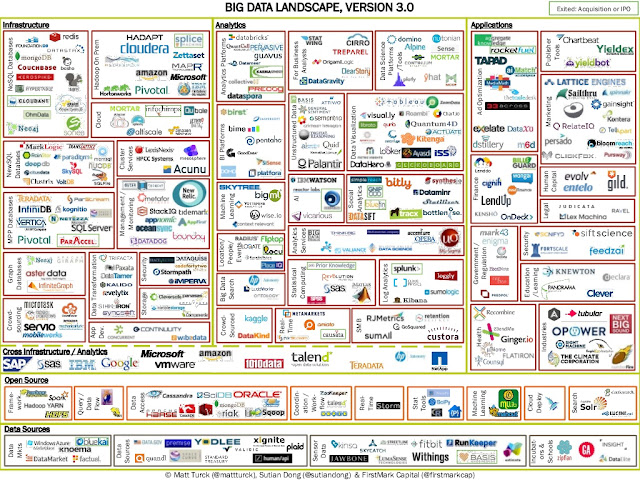
I don't know about you, but I'm a pragmatic. I like explanations, guidance, demonstrations to be clear, without any jargon or 'smoke' so that I can grasp and understand clearly what my interlocutor communicates. And one of my frustration within the Big data fuzzy world is that you already have thousands of possibilities, zillions of data sets and nearly that many programming languages in order to process data. If you don't believe me, have a look here below: But, that being said, let's focus on some clear, straight forward R text data mining solutions that you could find on the Qualitative Research in R blog. Check the link!

Switching your mindset to a revenue-generating CIO

I just read an HBR paper about the new mindset of the CIO (even if you can wonder if human beings are that binary...some projects can be revenue generating and some others are and will remain costs) - transforming a classical cost-centric to a revenue-generating department. One of the most interesting part of the publication are the four areas where CIO's and their corporations are looking for a new market approach: Digital products and business models: This means a shift from selling the equipment that runs a factory, for example, to selling performance information about that equipment along with insight about how to optimize its performance. GE has become a popular exemplar of this, as it leads the way to the digital industrial future. By the end of 2017, revenue growth from information-based products will be double that of the rest of the product/service portfolio for one-third of Global 2000 companies, according to IDC. Digital operations: Transformation of everything...